The Store Owner Nobody Talks About
Ebenezer Oyinlade
April 8, 2026
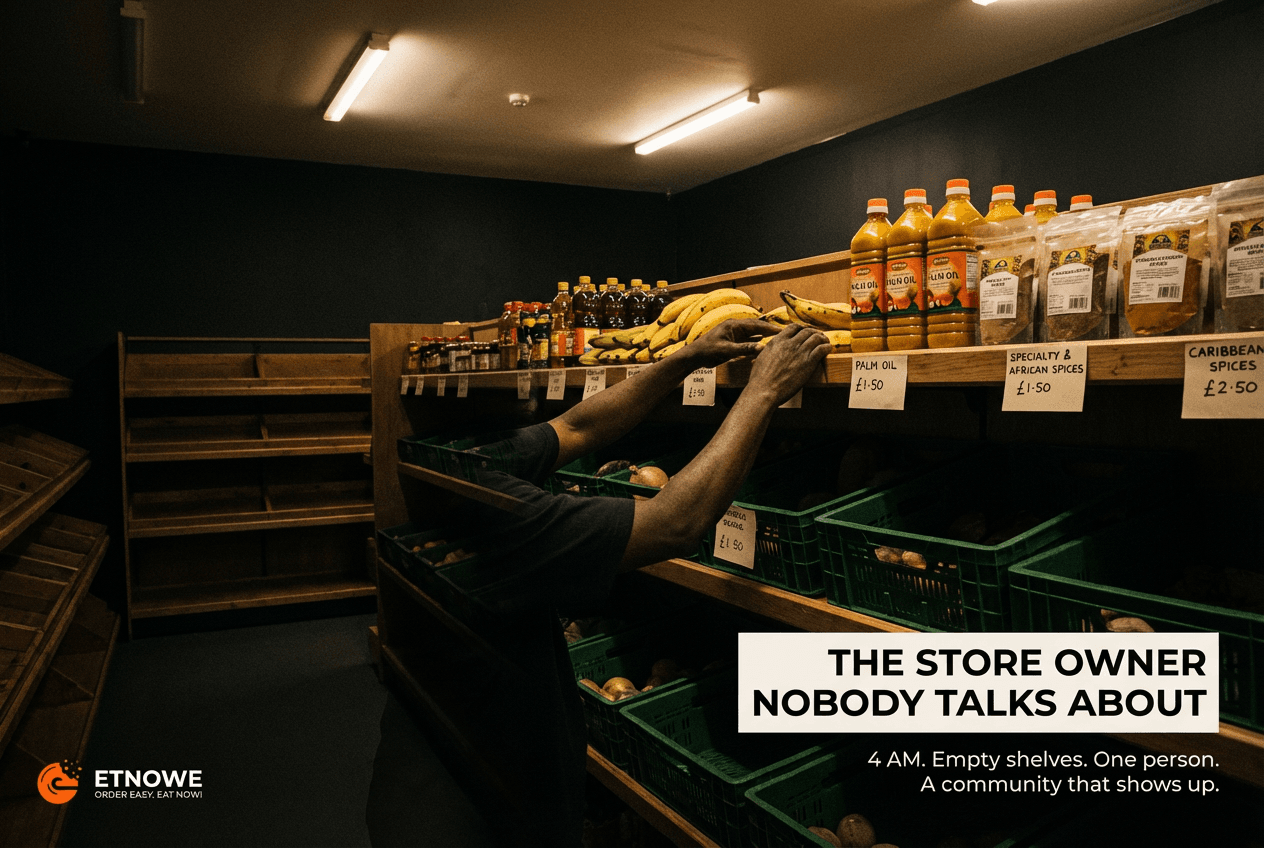
It’s 4 AM. The shelves are empty. A man whose name you’ll never know is already there, unloading boxes of egusi, placing bottles of palm oil in just the right spot, arranging yams so they catch the eye when you walk in at 7 AM looking for the ingredients no other store in town will carry.
This is the store owner nobody talks about.
When we talk about food delivery, we talk about logistics. Speed. Technology. AI recommendations. We talk about the platforms that have fundamentally changed how people shop. We talk about convenience, efficiency, the rise of on-demand everything. But there’s an entire layer of people, stores, and decisions that exist behind the scenes. The woman who opened a Caribbean grocery because she couldn’t find ackee anywhere in her city. The man who left a corporate job to carry on his family’s grocery business, now in its third generation. The owner stocking shelves at 4 AM with no POS system, no website, no tech infrastructure. Just a dream and a community that shows up.
These store owners have a very specific problem.
For the first generation owners, many of whom came from abroad and started these businesses out of nostalgia and necessity, the story is simple. They saw a gap. Their communities missed home. The traditional ethnic grocery didn’t exist where they lived. So they filled that gap. They built a store. They became the place where people could find the ingredients that make their food taste like memory.
The second generation coming up behind them are different. They grew up here. They went to college. Some of them have advanced degrees. They understand technology. They see digital tools everywhere. So when they take over a store, or start a fresh one, they want to scale. They want to use those tools. They want to grow.
But here’s where the story gets hard.
Both generations, whether they came with just determination and nostalgia, or with education and ambition, face the same wall. The platforms that have money, that have reach, that have customer trust. The ones that show up first when someone searches for grocery delivery. And every one of them takes a cut. A minimum of 15 percent. Sometimes up to 30 percent on a single order.
When you’re a store owner running margins of 8 to 15 percent on groceries, a platform fee that eats most of that doesn’t just reduce your profit. It inverts it. It turns a profitable order into a loss.
So you make an impossible choice. You either pay the fee and lose money on every delivery order while hoping someone walks in the door to buy at full margin. Or you stay off the platform entirely and accept that most of your potential customers will never know you exist.
I talk to these store owners now. They tell me the same thing every time. After the platform fees, after the payment processing charges, after everything is said and done, they’re working 12 to 14 hour days, 6 or 7 days a week, and there’s barely anything left. They’re not in this business to get rich. They’re in it to survive and bring the profit home.
But the profit never comes.
Some of them are losing $0.50 to $2 on every delivery order. They know this. They run the numbers. They understand that mathematically they’re losing money. But they stay on the platforms anyway because customers expect it now. Delivery has become the baseline. If you’re not on an app, you might as well not exist.
This is the trap. And almost nobody is talking about it.
ETNOWE exists because I understood something from the inside that most platforms missed. This problem isn’t just about customers. It’s not just about convenience. It’s about business sustainability. It’s about whether a store owner can actually survive and build something in this country.
We charge lower fees. That’s part of it. 10 percent. But the fee structure is actually the smaller piece.
What matters more is that we built this for store owners, not in spite of them. We understand that a store owner isn’t trying to be a tech company. They want to reach more customers. They want those customers to find them. They want to keep the profit.
We give them tools that work for them. Cultural understanding. Seasonal peaks and seasonal declines that we know because we’re not outsiders analyzing data. We’re part of these communities. We speak the languages. We know why January is slow and September is busy.
And we have a model that works. Zero commission for in-store pickups. That means a store owner can promote pickup on their own community channels, and keep 100 percent of the margin.
ETNOWE isn’t just for shoppers. That’s the whole thing. It’s the bridge these store owners never had. The person who stocks shelves at 4 AM, the first generation owner running on nostalgia and love, the second generation with education and ambition. They’re all trying to do the same thing. Build community. Survive. Take the profit home.
We made a platform for that.