Food Is How We Remember Home
Ebenezer Oyinlade
April 24, 2026
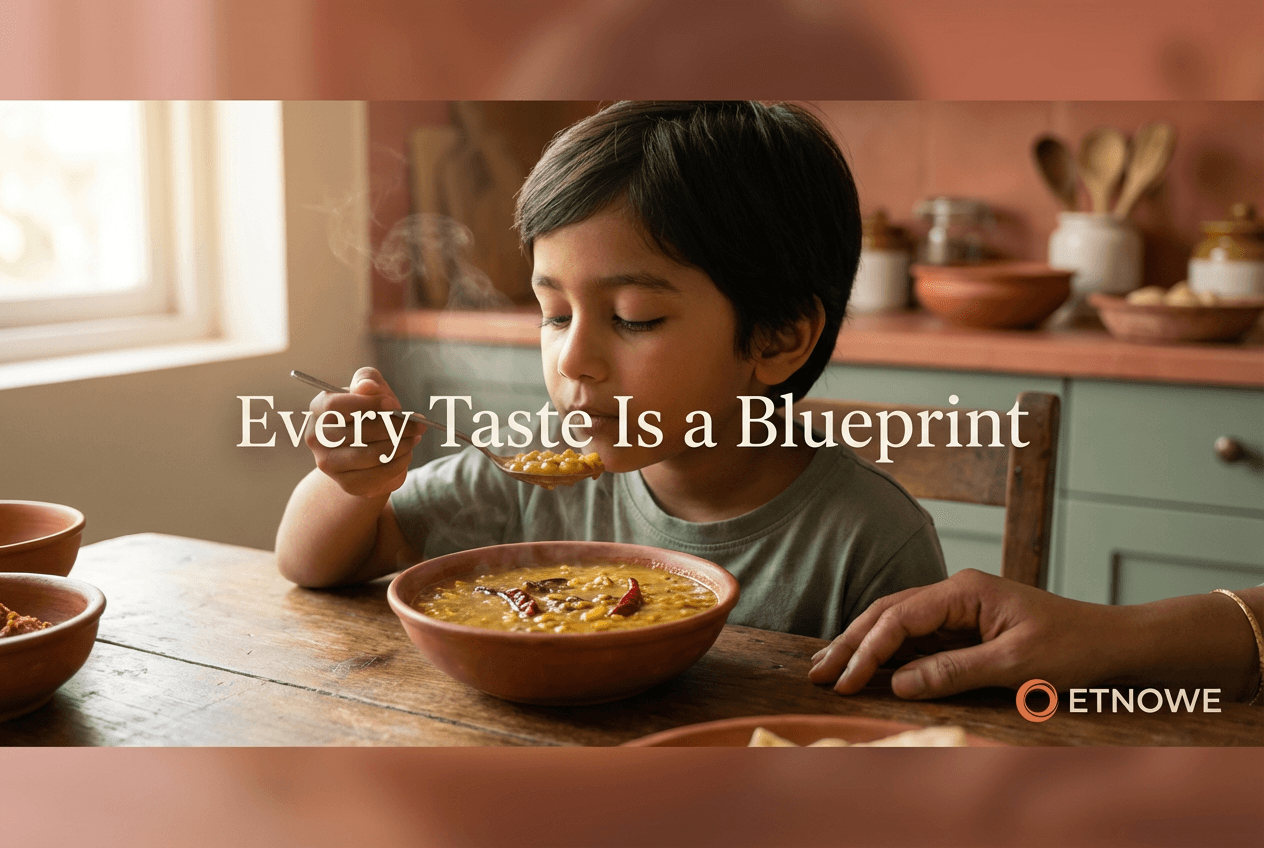
It started with a plastic container from a friend's house. My seven year old son, Tishé, opened it with the kind of suspicion only a child can muster. Inside was efo riro.
His mother makes efo riro the way her mother taught her, spinach wilted just past tender, that precise balance of pepper heat and savory depth. She could make it in her sleep.
Tishé took one bite. He shook his head. "This is not my mom's."
He was not being picky. He was being a guardian.
Every taste we grow up with becomes a blueprint. It settles into our mouths before we have words for flavor. My son's palate had already written down the exact version of efo riro that means home.
When it showed up different, his body simply rejected it. Not as bad. Not as wrong.
Just not his.
This is how food works in the diaspora. We carry our mothers' kitchens inside us.
A Ghanaian family in New York carries the taste of waakye prepared at 5 AM. A Dominican family in Florida carries the weight of tostones fried to that specific golden-brown. A Nigerian family in Ohio carries the delicate char of jollof rice cooked over the right heat.
These tastes are not preferences. They are neural imprints. They are how we know who we are.
The science backs this up. Memory tied to taste and smell activates deeper parts of the brain than memory tied to sight or sound. Food connects to the amygdala and hippocampus in ways that create what researchers call "implicit memory."
It is not something we recall. It is something we feel, instantly and involuntarily, the moment the flavor hits our tongue.
But here is the harder part. When we taste food prepared by someone else, someone outside our family, someone from our culture who has spent their life perfecting this dish, something shifts. The restaurant or the market vendor or the food service has spent years studying baseline flavors.
They have cooked this dish five thousand times. They have adjusted for water quality and ingredient sourcing and the subtle ways that technique creates authenticity.
When that food lands on your plate and the taste matches the taste in your memory, the effect is almost celestial. It is not just eating. It is remembering with your entire body.
It is the bridge between childhood and now. It is proof that you are not alone in carrying this specific taste, this specific version of home.
Tishé's rejection of his friend's efo riro was not the end of the story. Weeks later, we ordered efo riro from a restaurant. A place where the cook has been perfecting that dish for years. The moment Tishé tasted it, his face changed.
He did not say much. He did not need to. The restaurant had nailed the baseline. His body recognized itself in the flavor.
This is what happens across diaspora communities everywhere. A second generation kid becomes a taste gatekeeper because they are measuring everything against the baseline their mother or grandmother created.
But they are also hungry for evidence that others in the world remember the same way they do. When they find a restaurant, a market, a cook who nails it, they have found a witness. Someone else who carries this memory.
The 304 million people in the diaspora globally, the 52 million of us living in the United States, we all carry these tastes. We all have versions of dishes that ping something ancient and essential in us. And we are all searching, in one way or another, for the people who remember the way we remember.
This is why authentic restaurants run by people from the culture matter so much. It is not snobbery. It is recognition.
It is the difference between eating something that tastes similar and eating something that is true to the taste you grew up with.
The woman cooking efo riro in a kitchen in Lagos has spent her entire life perfecting that dish. The man making jollof rice in an Accra market has made that same dish his whole life. When they bring those dishes to diaspora communities, they bring the baseline.
They bring the version that matches the neural imprint. They bring home.
Food is also how we learn about each other. A kid in a multicultural household tastes his friend's mother's cooking and discovers that there is another way to make rice, another way to season beans. He expands his baseline.
He becomes multilingual in taste.
This is how cultures in diaspora speak to each other. Not in meetings or policy documents. In food.
The restaurant industry in diaspora communities knows this. Mothers and fathers and grandparents have opened restaurants precisely because they understood that their community was hungry not just for food, but for the specific taste of memory. The multicultural grocery market in the United States alone is worth fifty billion dollars because people will seek out the exact spice blend, the exact brand of palm oil, the exact cut of meat that matches the way it was done at home.
But here is what also matters. Access to that food should not require a three hour drive or a trip to a neighborhood that is not safe at night. The diaspora is not one neighborhood.
It is spread across cities and suburbs and towns. It is in office buildings and shopping centers and on residential streets.
The food that holds our memories should be available where we live. The taste that brings us home should not be a luxury.
It should be a given.
This is where the story intersects with delivery. When you can order efo riro from a cook who learned it from her mother, and have it arrive to your home in an hour, something shifts.
The gap closes. The memory becomes accessible. You are not traveling to find home.
Home is traveling to you.
Tishé will carry his mother's version of efo riro with him his whole life. He will search for it in new cities if we move. He will taste it and feel connected to his mother, his heritage, his roots.
If we make it easy for him to find versions of this dish that are true to that memory, we honor both him and the people who have kept these traditions alive.
Food is how we remember home. It is also how home finds us.
If this resonates, experience what we are building. On iPhone? Download the ETNOWE app on the Apple App Store. On Android? Get the ETNOWE app on Google Play.